
Olathe Criminal History Checks
Start close to the event. The Olathe Police Department is the first custodian for an Olathe incident or arrest report. The town has no identified police-record portal, online form, public blotter, records email, or records app. A call or counter visit is therefore more useful than a web search. Give the name, date, place, and ticket or report number when known. Those facts help staff distinguish a police narrative from a municipal court file.
Then follow the case by jurisdiction. An ordinance citation remains with Olathe Municipal Court. A state-law charge or a custodial arrest moves to the county jail and the appropriate county or district court. CBI receives reported, fingerprint-supported events, but its response does not replace an agency report or the final court file.
- Call Olathe Police at 970-323-5601 for the originating report and ask what identifiers, payment, or written request the office needs.
- If written access is needed, direct a focused CCJRA or CORA request to the Town Clerk at Town Hall.
- Ask Olathe Municipal Court about an ordinance or traffic ticket by its ticket or case identifier.
- For custody or state charges, use Montrose County jail and court channels instead of treating the town file as complete.
- Use the CBI Internet Criminal History Check only for the reported Colorado name-based history layer.
Olathe Police Reports Cost $5
Olathe’s municipal court fee list supplies a useful local answer that the police page does not: a police report is listed at $5. Confirm the current amount and availability before paying, since the research found no separate police fee schedule or online request screen. A report may also need review or redaction if it contains protected juvenile, victim, witness, or active-investigation material.
The official Olathe Municipal Court page is also the source for the court schedule and payment choices. Its screenshot shows the local court context where the police-copy price is published.
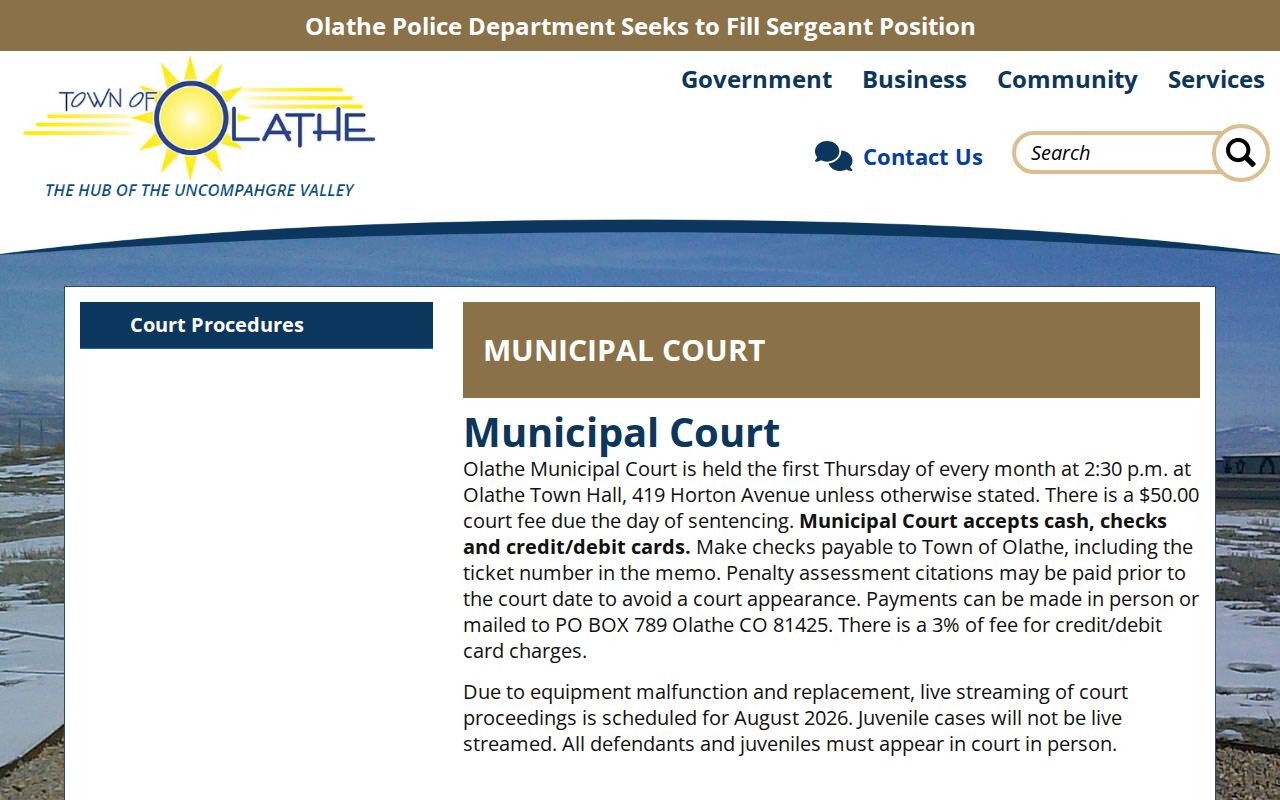
That placement matters. The $5 entry identifies a copy charge, not an online criminal-history product and not a promise that every requested report is open.
Records at the Olathe Police Department
Olathe Police is presented as a current town department at 420 South Horton Avenue. A 2025 records-technician posting describes the local work behind a request: processing and releasing police records and sending documentation to the Seventh Judicial District Attorney and Olathe Municipal Court. That confirms why the police file can be the earliest record in the chain while the later charge and disposition appear elsewhere.
A 2024 agreement described interim sheriff police-chief services. It did not establish that the sheriff permanently replaced Olathe Police, and current town pages still present and recruit for the department. For a current report, use the town contact rather than making assumptions from that temporary management arrangement.
The official police page provides the source view of the department and local contact point.
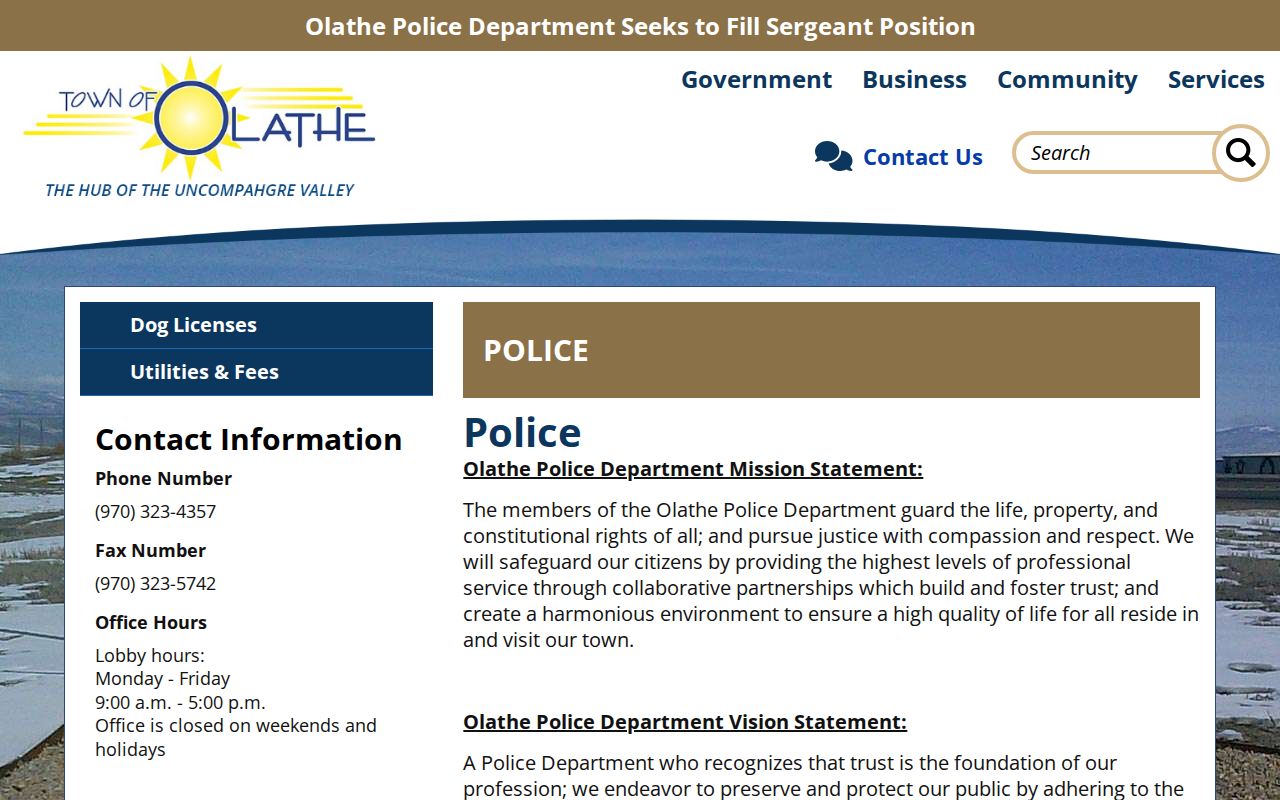
The image identifies the correct local agency, while the underlying record still must be requested by phone, counter, or the written clerk fallback.
Olathe Police Department
420 South Horton Avenue
Olathe, CO 81425
970-323-5601
Town Hall and Clerk
419 South Horton Avenue
PO Box 789
Olathe, CO 81425
970-323-5601
Olathe Arraignment Is Not Trial
The first municipal court date is an arraignment. At that appearance, the judge explains the charge, rights, and possible penalties, then calls the docket. It is not the trial itself. That distinction helps a reader interpret a court entry correctly: an arraignment shows that a case reached an initial plea stage, not that guilt was proved or a final result entered.
Olathe Municipal Court normally meets on the first Thursday of each month at 2:30 p.m. in Town Hall, unless the town announces a change. Judge Dan Hotsenpiller serves the court, and Clerk and Community Outreach Coordinator Robyn Casias is the listed clerk contact. Call 970-323-5601 before travel because the schedule is monthly, not a daily records counter calendar.
Note: A charge, citation, arraignment, or booking is not a conviction; only the court’s disposition states how the case ended.
Booking and Arrest Records in Olathe
Olathe does not publish an identified town jail roster. When an Olathe arrest is custodial, the person routes to the Montrose County detention system. The county inmate list may then show a booking number, name number, statute, offense, court, offense code, and class. It does not supply the police narrative, bond, booking time, court date, release date, or final disposition.
That split makes two requests useful. Ask Olathe Police for the report that describes the local event. Use the county booking source for current custody facts, then the filing court for charges and outcome. The fuller county process is addressed in the Montrose County arrest search. Do not treat a person’s absence from a current jail list as proof that no Olathe arrest occurred.
Olathe Court or County Record
The conduct and charge determine the record path. A town ordinance or local traffic matter remains at Olathe Municipal Court. State misdemeanors, felony preliminary matters, and felony cases proceed through Montrose County or District Court. Custody records belong to the sheriff even when Olathe officers made the arrest.
| Olathe event | First record holder | Next official layer |
|---|---|---|
| Town ordinance citation | Olathe Police | Olathe Municipal Court |
| Custodial arrest | Olathe Police report | Montrose County jail |
| State misdemeanor | Originating agency | Montrose County Court |
| Felony allegation | Originating agency | District Court and CBI reporting |
Search the channel tied to the fact needed. The source of a narrative, custody status, charge, and disposition will often be four different offices.
The Olathe Municipal Court File
No public name-based Olathe case lookup was located. Use ticket and case identifiers with the clerk by phone or at the counter. The court can distinguish its own ordinance and traffic file from a county case that only began with an Olathe police contact.
| Court Name | Town of Olathe Municipal Court |
|---|---|
| Case Types Heard | Town ordinance and local traffic matters |
| Case Lookup Channel | Phone or counter with ticket or case identifiers; no public search form found |
| What the File Shows | Charge, arraignment, pleas, settings, orders, and disposition as maintained by the clerk |
| Copies and Fees | Court $75, bench warrant $50, appearance $75, papers served $15, police report $5, returned check $20 |
Cash, check, and card are listed. Card payments add a three-percent surcharge. Checks are payable to the Town of Olathe and should carry the ticket number. The court fee is due on court day.
Olathe Court Payment Choices
Payment information can help locate the correct local file, but payment does not function as a case search. Call the clerk when a ticket number, due amount, warrant status, or appearance duty is unclear. A bench warrant is listed at $50, yet paying a fee should never be assumed to clear a warrant without direct court confirmation.
| Item | Listed amount |
|---|---|
| Court fee | $75 |
| Bench warrant | $50 |
| Appearance | $75 |
| Papers served | $15 |
| Police report | $5 |
| Returned check | $20 |
Note: Confirm the current balance, required appearance, and accepted method with Olathe Municipal Court before sending money or traveling.
How Olathe Records Reach the County
Police create the incident or arrest report. Their records work can send documents to Olathe Municipal Court for local matters or to the Seventh Judicial District Attorney when state charges are considered. A custodial booking adds a sheriff record, and the proper county or district court creates the official case file. Reported fingerprint-supported events and dispositions can later enter CBI’s Colorado history system.
Record flow: Olathe Police Department › Olathe Municipal Court or Montrose County Courts › Colorado Bureau of Investigation
The newest fact is often closest to Olathe. The most authoritative outcome is at the court. CBI is useful for a wider Colorado check, but tickets, summonses without fingerprints, sealed records, most juvenile matters, and missing dispositions may not appear in its public product.
Olathe Criminal Record Statistics
CBI Crime Statistics includes Olathe Police Department as a selectable agency. The controls cover years 2008 through 2026 and themes such as hate crime, DUI and drugs, violent crime, property crime, motor vehicle theft, and domestic violence. Select Olathe Police Department, a year, and a theme, then use GO.
The output is agency-level context, not a list of people and not proof of what happened in one case. Annual counts were not extracted in the research, so none should be inferred. The portal is most useful for understanding what the reporting agency submitted under a selected theme while a person-specific Olathe record check remains with police, court, county, and CBI history channels.
Olathe Clerk Records Fallback
When a phone or counter inquiry does not resolve a request, the Town Clerk is Olathe’s written open-records fallback. The clerk’s page assigns open-records and transparency duties to that office. A narrow request should name the agency, event date, location, person, report or ticket number, record sought, and preferred format. That detail reduces the risk of a broad search and helps the town route criminal-justice material under CCJRA rather than treat it as a general administrative record.
The Town Clerk and Administration page is the official source for this local fallback.
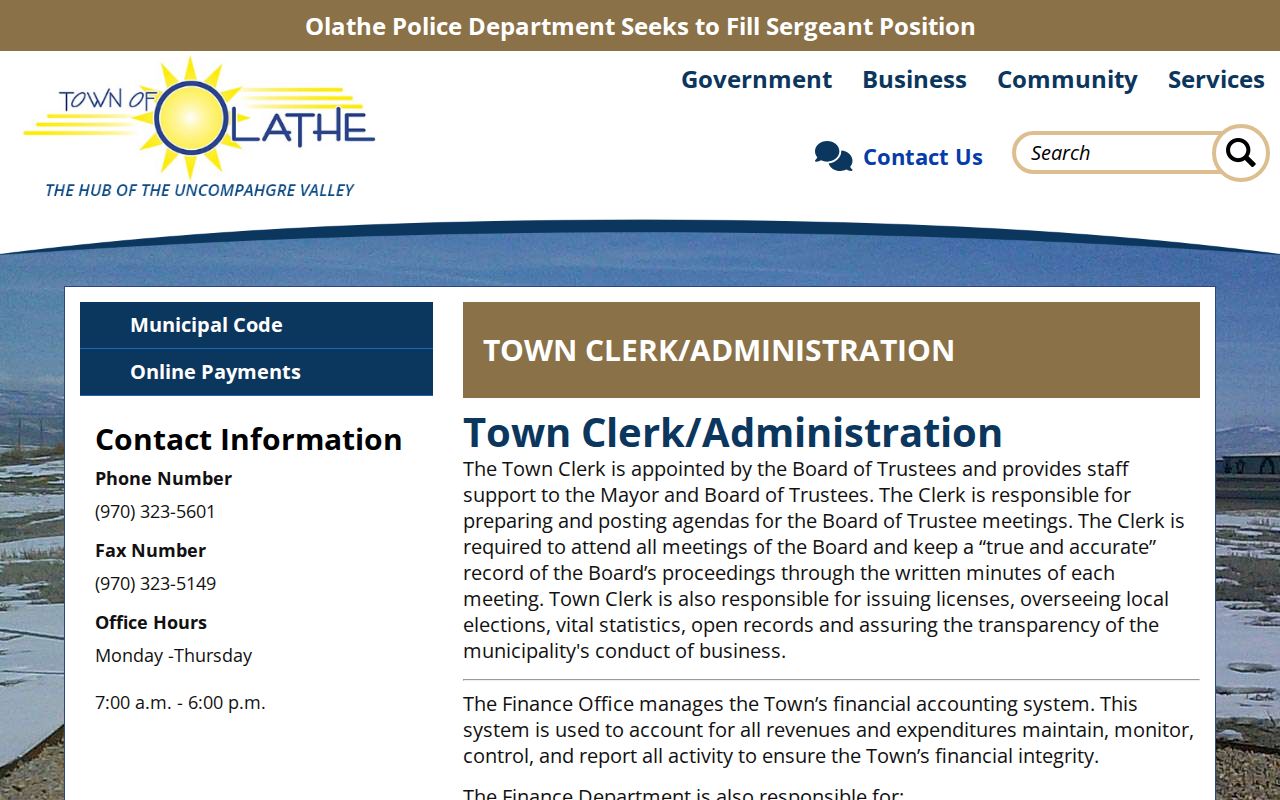
The clerk route fills the online-form gap, but it does not make protected material public. The town may withhold or redact information barred by statute or court order.
Olathe Record Access Rules
Colorado separates criminal-justice records from general public records. Olathe police reports are governed chiefly by CCJRA, while general town administration records fall under CORA. A custodian may review active-investigation content, juvenile records, victim and witness identifiers, sealed files, and security-sensitive facts before release. Municipal court access also follows Colorado Judicial public-access rules.
Key Statutes:
CCJRA, CRS §§24-72-301 through 309 governs inspection, release, fees, redaction, and denial of criminal-justice records.
CORA, CRS §§24-72-201 through 206 applies to general public records held by the town.
CRS §19-1-304 protects much juvenile justice information from public disclosure.
A denial or redaction should be addressed first with the custodian in writing. Ask which statute or court rule controls the decision. A record’s existence does not mean every line can lawfully be released.